79,290
Albertans being moved from AISH to ADAP on July 1, 2026
Source: Alberta AISH Caseload Open Data, Sept 2025
Public Interest Brief · April 2026
AISH, ADAP, FSCD, PDD, primary care, appeals — each system is failing in a different way, and together they form a single trap. This site gathers the evidence, the arithmetic, and the flyers you can print and share.
⭐ Most popular — what people are using
AKG in the north and Serco in the south run employment services. They are not the people who decided you are disabled — a director did that, before you were ever sent to them. So taking part in the assessment and handing over your diagnosis are two different things, and you can do the first while declining the second. We read both instruments: no provision requires you to disclose your diagnosis to a contractor, and none ties a benefit consequence to declining. The consequences that are written attach to withholding information from the director, and to refusing employment supports — so take part, and keep those two lines apart when you speak.
Includes the words to say in the meeting, four questions to send them in writing, and what to keep afterwards. This does not tell you to skip the meeting or refuse to take part — that can carry a benefit consequence. Take part. Keep your medical history to yourself.
If you cannot work because of a permanent disability, you can apply to return to AISH. There is no deadline. As of July 2026 there's one combined application — the DS2444A, which you fill out, plus the DS2444B medical report your health professional completes.
The medical report guide is the most-read document on this site — worth reading before your health professional fills anything in. Also: how to fill out DS2444A.
Submit both (with supporting documents) by fax 1-877-969-3006, or mail to: AISH and ADAP, PO Box 17000 Station Main, Edmonton AB T5J 4B3. One panel decision placing you on ADAP is final — build your case strong the first time.
Get a free copy of your own AISH file through Access to Information, so you can see what's on record and catch any gaps before a reassessment or appeal. They have 30 days to respond, so request early.
The fill-in version opens in a browser and can be typed straight into. The government original must be saved first and opened in Adobe Reader — it will not open inside a web browser.
Your cheque can be docked $200 for the Canada Disability Benefit even if you were denied it, are still waiting, or were approved for less than the full amount. If that $200 came off but doesn't match your real CDB status, the correction letter tells AISH to deduct only what you receive. And if it was already taken when you weren't getting the federal benefit, the repayment request asks them to pay it back — by their own law, they must.
If your disability makes part of the process hard or impossible — phone calls, travel, short notice, long forms, being asked things you cannot reliably answer on the spot — you can ask for it to be done differently, in writing. Asking is not refusing. A request for accommodation should never be recorded as a refusal to participate, and if they refuse or go silent, you hold written proof that the barrier was raised before anything was missed.
Print-and-write versions: barriers notice · large-print accommodation request.
On ADAP, section 16(a) requires you to report when your employment is reduced or ends. Section 15(4)(a) makes "reduced or terminated" employment a ground to refuse, suspend, vary or discontinue your benefit. The regulation draws no distinction between someone who will not work and someone who cannot. There is no exemption for illness anywhere in it. This applies to ADAP only, not AISH.
MS, lupus, ME/CFS, Crohn's, bipolar, long COVID, epilepsy, migraine, fibromyalgia, EDS — anything episodic. The power is discretionary ("may"), and we know of no case where it's been used. The point is that it exists and nothing is written against it.
On whether a section 15(4) cut can be appealed: this card previously said it could not. Our FAQ says it can. We have taken the claim down rather than leave two answers on one site, and we are re-checking it against the current regulation before we say either way. In the meantime, never accept a flat "you cannot appeal that" without asking, in writing, which exemption they are relying on.
Starting July 2, ADAP will call you about employment services and ask you to help build a plan. Filling this worksheet out first — at home, on your own terms — is participating, as the expert on your own life. Bring your goals, your real needs, and your accommodations already written down, so the plan is built around what you said. It's yours to keep: bring the original, let your worker take a copy. Three versions below — pick the one that fits you.
If you're 60 or older, in continuing care, terminally ill, or have a developmental disability or PDD eligibility, you stay on AISH automatically. If you still received an ADAP move letter, that's a coding error — this request asks them to correct your category and keep you on AISH.
Search
Search the whole library by keyword — matches titles and descriptions across every report, document, reference source, Take Action form, and Ministerial letter.
No matches. Try a different keyword.
New Release · Last 7 days
Everything added to the library in the last week, in one place. After 7 days each item rolls into its permanent home in Reports, Documents, or Audio — nothing disappears, it just stops being "new."
Nothing has dropped in the last 7 days. Check back — or browse the full library below.
Updated most days
Where Things Stand — a plain-language update on where the AISH → ADAP transition sits and what it means for you. No jargon. The newest update is first; earlier days are below it.
Peer information
These are the questions our community keeps asking, and the answers we have worked through together. This page exists so that people who are not on Facebook can find the same information. It is peer information, not legal advice — for your own situation, confirm with the program in writing. Alberta Supports: 1-877-644-9992.
Answers reflect the rules as of July 2026 and will be updated as things change. Key figures on this page have been checked against the government's own pages and policy manual.
From the group
The longer posts from our community that are worth keeping — the breakdowns, the myth-busting, the corrections, and the nightly notes. This page exists so people who are not on Facebook can find them too. Peer information, not legal advice — for your own situation, confirm with the program in writing.

In their own words
The numbers tell part of this story. These are the people living it — Albertans sharing, in their own words, what the AISH → ADAP transition means for their lives. To add yours, reach us at albertadisabilitybreakdown@outlook.com.
Some of these stories are hard to read. If you are struggling, you can call or text 9-8-8 any time, day or night, for support.
A rose, for the ones we carry
The pink ribbon rose is our remembrance — for the ones who fell without support, the people in our community who did not make it through. When you wear one, it tells the living they are not alone, because someone across a room wearing the same rose is someone who understands.
The pins are always free — no charge, not now, not ever. Request up to five.

Numbers
All figures from Government of Alberta open data, Statistics Canada, and verified independent sources. Every number cites its source in the underlying reports.
79,290
Albertans being moved from AISH to ADAP on July 1, 2026
Source: Alberta AISH Caseload Open Data, Sept 2025
$1,901
Maximum monthly AISH benefit — already $6,004 below the poverty line annually
Source: Maytree, Welfare Incomes Across Canada, 2024
3 yrs
FSCD/PDD waitlist for children's disability services — same families, same homes
Source: Alberta FSCD/PDD intake data, 2025
0
Independent appeal rights for AISH/ADAP eligibility decisions after Bill 12
Source: Bill 12, Government of Alberta, passed Dec 9, 2025
$200/mo
Federal Canada Disability Benefit — clawed back dollar-for-dollar in Alberta only
Source: Alberta is the only province in Canada to do this
650,000
Albertans without a family doctor — including most AISH recipients
Source: Alberta Doctors' Digest, Nov/Dec 2025
The System
Each program below is failing on its own terms. Read each pillar — and then read how they interact, because they were never designed to interact at all.
I
79,290 Albertans on AISH are being moved to a new program on July 1, 2026. The eligibility criteria for ADAP have not been published. Bill 12 removed independent appeal rights. The $200/mo federal Canada Disability Benefit is clawed back dollar-for-dollar — the only province in Canada to do this.
Financial Reality Report →II
Most psychotherapy is not covered by AHCIP or AISH benefits. Psychiatry waits run 6–18+ months. 650,000 Albertans have no family doctor. The healthcare worker shortage compounds every other system in this list.
Health Benefits Erosion Report →III
The same families being moved off AISH have children on the FSCD/PDD waitlists. Average wait: three years. Intakes have been quietly closing. The disability income system and the children's disability service system are failing the same households simultaneously.
Three Years and Counting Report →IV
Bill 12 removed independent appeal rights for eligibility decisions. Caseworker authority expanded. The Alberta Human Rights Commission is still available, but the front-line mechanism most disabled Albertans actually use is gone.
Caseworker Appeal Rights Report →Appeals
Before December 9, 2025, an Albertan denied AISH could appeal to an independent body. Bill 12 removed that. Eligibility decisions for AISH and ADAP now sit with the Minister, with no independent reviewer between you and the program.
The reports linked here document the change clause-by-clause, examine what's left of the appeal process, and lay out the Charter mobility-rights argument and the constitutional analysis.
Flyers
One-page flyers built to stick on bulletin boards, fold into envelopes, and share in group chats. Each one ties to a sourced report.
Images and illustrations are AI-generated.
Reports
19 sourced reports plus the full compilation. Every figure traces to government open data, Statistics Canada, peer-reviewed research, or primary-source government correspondence.
Start here
All 19 reports in one PDF. The single file most people want.
Documents
Compilations, sourced briefs, plain-language guides, legal analyses, and the Indigenous Disability and Systematic Exclusion document series.
Reference Library
Third-party and government-authored sources the campaign cites — statutes and regulations, government manuals and forms, financial statements, official info pages, external reports, news coverage, and the ADAP engagement record. Distinct from the campaign-authored material in Documents above.
Ministerial Correspondence
Direct correspondence from the Government of Alberta in response to formal submissions. Each letter is a primary source. Each one confirms or contradicts the program description in writing.
April 28, 2026 · First substantive Ministerial response
The Honourable Jason Nixon, Minister of Assisted Living and Social Services, responded by formal Ministerial response from the Minister's office to the formal submission addendum filed April 15, 2026. Read the response, then read what it reveals, confirms, and avoids.
Audio
Every major report in the campaign archive, recorded as audio. Listen in the browser, download to your device, or share the link. Free to share. Free to save. Free to distribute.
Podcast
Hosted by Gavin Sorochan of NightCastle Productions in collaboration with The Alberta Disability System Breakdown. Live streams Mon · Tues · Wed · Fri, 3–5 PM MT. Archived after broadcast. Watch the latest episode below — the player updates automatically when a new episode is uploaded.
Latest episode plays first. Use the playlist menu (top-left of the player) to browse all episodes.
Allied Voices
We don't have to align. We don't have to agree. We are all headed to the same destination — stop ADAP, stop the ableist agenda, end the cuts to disabled Albertans. Anyone speaking for, on behalf of, or with the disabled community deserves a seat at this table — whether they have accepted it or not. The voices below are not endorsements. They are recognition that this fight has more than one voice, and that the people in it deserve to be heard, in their own words, on their own platforms.
Disability advocate · People's Alliance for Disabled Albertans.
Watch on YouTube →Independent anti-ableism advocacy and commentary.
Watch on YouTube →Provincial inclusion organization advocating for Albertans with developmental disabilities and their families.
Watch on YouTube →National inclusion organization advocating for the rights of Canadians with intellectual disabilities and their families.
Watch on YouTube →Disability advocate · Executive Director, Can Man Dan Foundation.
Watch on YouTube →Alberta-based disability rights foundation supporting people with disabilities and their communities.
Watch on YouTube →Independent disability advocacy and commentary.
Watch on YouTube →Marie Renaud, MLA for St. Albert, has been one of the most consistent and engaged provincial voices on AISH, ADAP, and disability policy. Her speeches, questions, and committee work appear on the Alberta New Democrats channel, where she does much of her public advocacy.
Watch on YouTube →Know a voice in this fight that should be on this list? Email albertadisabilitybreakdown@outlook.com. Inclusion is not endorsement. The table is open.
Take Action
Fillable templates that do the heavy lifting. Edit the bracketed sections, sign, send. Every letter is a record.
The campaign's central direct-action letter. Three pages, sourced to the government's own May 12, 2026 fact sheet, with five on-the-record questions and a personal impact section. Sent to Minister Neudorf, copied to the Premier and your MLA. The transition is in 40 days.
Open letterThe same letter, rewritten for parents, spouses, adult children, friends, support workers — anyone whose standing comes from what they've witnessed. No legal guardianship required. Every witness is a record.
Open letterSelf-declaration for AISH recipients asserting eligibility for automatic AISH retention under the categories published in the May 12, 2026 ADAP Fact Sheet — for recipients whose qualifying condition meets one of the auto-retention criteria and who intend to remain on AISH rather than be transitioned to ADAP on July 1.
Open formCompanion to the Recipient Statement for parents, spouses, adult children, guardians, support workers, and anyone else with standing to witness the recipient's eligibility for automatic AISH retention. Use when the recipient cannot self-declare, or alongside the Recipient Statement for a paired submission.
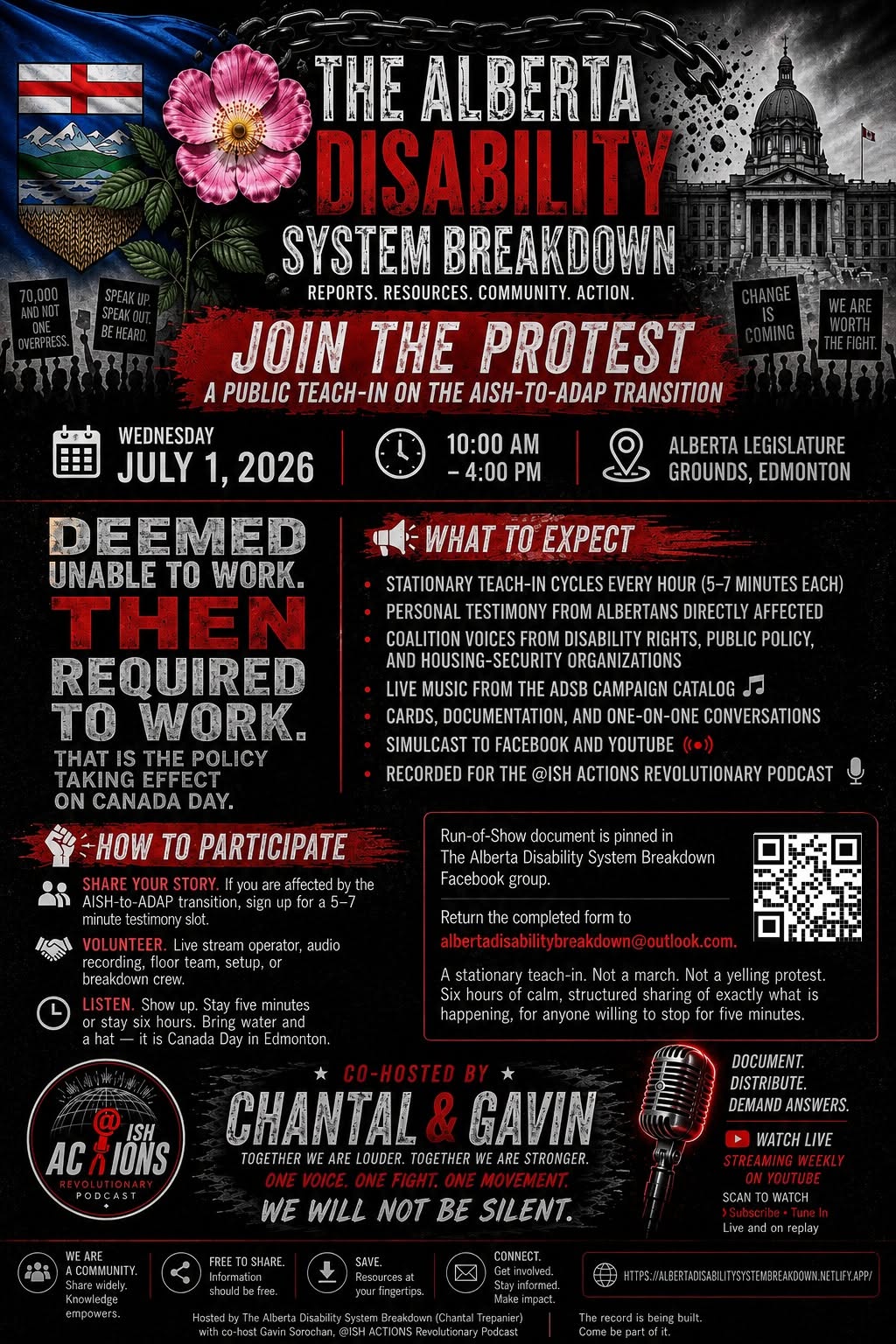
Open formCommunity run-of-show for the Canada Day teach-in at the Alberta Legislature — the day the AISH-to-ADAP transition takes effect for 79,290 Albertans. Schedule and scripts are cemented; coalition, testimony, and volunteer signup sections are fillable. Send completed file to albertadisabilitybreakdown@outlook.com. 10 AM–4 PM, Edmonton.
Open run-of-showThe single most effective document in this kit. Bracketed sections only — the rest is ready to send.
Open templateTell the government what the transition means for your household. Submitted to the public record.
Open templateFor people whose story belongs in the campaign record, but not in their MLA's inbox.
Open template Printable versionThe appeal window closed June 30, 2026. This form is kept for reference. If you cannot work because of a permanent disability, the open path now is reassessment — see the notice at the top of the page.
Ask AISH to reconsider a recent decision before you file a Notice of Appeal. Once a Notice of Appeal is filed, the AISH Policy Manual prohibits the Appeal Panel from considering any new information.
Open form (reference)The appeal window closed June 30, 2026. This form is kept for reference. The open path now is reassessment — see the notice at the top of the page.
A formal Notice of Appeal letter for an AISH decision — fillable, or a ready-to-print-and-sign version.
Open fillable (reference) Print & sign (reference)When you move to ADAP, someone will call you about employment services and ask you to help build a plan. This worksheet means you don't walk in cold. Fill it in first, at home, on your own terms — as the expert on your own life. It has plain-language pages on what to expect and how to be heard, a breakdown of what your ADAP letter really means, the Alberta Supports numbers, and space to write your goals, what you can and can't do, the accommodations you need, the barriers in your way, and the letters that back you up — with an example for every section. Take your time; you can do one part a day, and ask someone you trust to help. It's yours to keep: bring the original to your meeting and let your worker take a copy. Three versions: fill on screen in colour, fill on screen printer-friendly, or print and write by hand.
Fill on screen (colour) Fill on screen (printer-friendly) Print & write by handYou must report the very thing that can be used against you. Section 16(a) of the ADAP regulation requires you to notify a director when your employment ends or is reduced. Section 15(4)(a) makes "reduced or terminated" employment a ground to refuse, suspend, vary or discontinue your benefit. The regulation draws no distinction between a person who will not work and a person who cannot — there is no exemption for illness, incapacity, or a flare anywhere in it. "Reasonable employment" is never defined. And these decisions are exempt from appeal. This power applies to ADAP only, not to people who stayed on AISH.
If you live with MS, lupus, ME/CFS, Crohn's, bipolar disorder, long COVID, epilepsy, migraine, fibromyalgia, or EDS — anything episodic — this is aimed at your life. The letter quotes the regulation verbatim and leaves you space to say, in your own words, what a flare actually does to you. That part is the most powerful thing in it.
Open letterIf you struggle to remember or process what's said at appointments, this asks your physician's consent to audio-record your own visit — so you have an accurate record. It follows the College of Physicians and Surgeons of Alberta's own guidance, which tells patients to explain their reason and ask consent first. Tick why you're asking (memory, cognition, anxiety, pain or medication, multiple providers) without naming a diagnosis. It also asks for fallbacks if recording is declined: a written summary before you leave, or a support person to take notes. Especially useful for a reassessment appointment, where getting the medical details right matters.
Open request Large print — print & writeA formal written notice to ADAP that your disability prevents you from taking part in employment programming, with a request for accommodation in writing. This is not refusing to participate — it's documenting that you're unable to. If ADAP grants accommodation, you get the exemption you need; if they refuse or don't respond, you hold written proof the program required participation and wouldn't address the barrier. Either way, the record is on your side. Fillable on any device, or print and complete by hand.
Open notice Print & write by handA consent form that lets an advocate act on your behalf — so someone you trust can speak to AISH, ADAP, the Appeals Secretariat, or a worker for you, and help with your file. You decide what it covers, and you can withdraw it at any time. Fill it on screen, or print it and complete it by hand.
Fill on screen Print & fill by handThe appeal window closed June 30, 2026. This letter is kept for reference. Your CPP-D approval is still strong evidence for a reassessment — see the notice at the top of the page.
If you have been approved for CPP Disability, this letter appeals your AISH decision on those grounds. CPP-D's federal test — severe and prolonged — maps directly onto the AISH severe-handicap test.
Open letter (reference)If the federal Canada Disability Benefit clawback has triggered an overpayment notice. Form template.
Open formDocument the $200/month CDB clawback even if your federal amount is less than $200, or hasn't arrived yet. Each completed form is a documented receipt — the pattern is what gets the system to fix it. Includes a full directory of every Alberta Supports / AISH office.
Open formSelf-declaration that fulfils your monthly AISH/ADAP reporting obligation in writing — in months you worked, didn't work, or had any status change. A paper trail protects your file when phone or email reports go missing or unrecorded. Cites the Government of Alberta's own reporting requirement.
Open formFor when AISH has processed your monthly benefit incorrectly because previously-reported information was not recorded in your file — benefit reduced or held to $0, paystubs lost, status changes never entered. Formal written request for file correction citing your reporting obligation under Government of Alberta policy.
Open letterFor anyone — or anyone you care for — in one of the four groups the government's own rules say automatically remain on AISH (a severe/profound developmental disability or PDD eligibility, a palliative or terminal condition, continuing care, or age 60+) who received an ADAP letter anyway. This is not an appeal — it's a request to correct an administrative error and to be told, in writing, who made the decision and why. Section 12.8 removed the appeal for the transition; it did not remove your place in these categories.
Open formFor when AISH or ADAP deducted the $200 Canada Disability Benefit amount but the deduction doesn't match the CDB status you reported — your application was denied and the $200 was taken anyway, it's still pending with no decision, or the status you reported wasn't recorded. A formal file-correction request citing your reporting obligation, asking for reversal where the deduction doesn't reflect federal income you actually receive.
Open letterFor when AISH deducted the $200 CDB amount but you were not receiving the federal benefit — you were denied, your application is still pending, or more came off than you ever received. When AISH pays you less than you were owed, that is an underpayment, and the AISH General Regulation does not say "may" — it says the director must repay the outstanding amount for the entire period. This form states what was deducted, quotes the law that requires repayment, and asks them to put the calculation in writing and pay you back. It's the mirror of the repayment form: that one is for when you owe them — this one is for when they owe you.
Open formA letter anyone can send directly to the Minister responsible for AISH and ADAP. It makes the human-rights case plainly: tens of thousands of people already assessed with permanent disabilities are being moved to ADAP with no new individual assessment and no independent appeal. Fill in your own story, send it to the Minister, and copy your MLA, the Opposition critic, and local media — your story is the evidence.
Open letterAn accountability submission to send to your MLA, the Minister, or any party leader. It sets out four examples drawn entirely from the government's own published record — the ADAP disability cut, the Access to Information transparency rollback, the unauthorized release of 2.9 million Albertans' voter data, and the $85M break-up of Alberta Health Services — and asks one question: where do you stand, and what will you do? Fill in your own story and send it across every party.
Open submissionFor caseworker, program, or service complaints that need a paper trail.
Open templateFor non-disabled allies, family, friends, professionals submitting on behalf of someone else.
Open templateRequest your own government-held records under the federal Access to Information Act and Privacy Act. Get the file the province has on you.
Open formIf you're considering relocating: each provincial brief documents what you're leaving Alberta to go toward. Sourced. Specific. Decision-ready.
Take Action
No printing, no envelopes. Pick a letter, and it opens in your email with the recipient, subject, and words already filled in. Edit anything in [brackets], then send. Nothing sends on its own — you always press send yourself.
Every button also copies the full letter to your clipboard, so if a long letter ever gets trimmed by your email, just paste. Prefer paper? Every letter still has its fillable PDF.
The Record
A complete, sourced package on the AISH-to-ADAP transition: the argument, the evidence, and the routes to act on it. It is built to be handed to a lawyer, a human-rights body, an international mechanism, a journalist, or an elected representative. The documents marked draft are working templates for completion by counsel; the dossier is the evidence they rest on. Everything traces to a primary source.
The letter that introduces the package. It explains what the transition did, why the harm is foreseeable rather than speculative, and what you are asking the recipient to do. Fill in the recipient and your details, and send it on top of the four documents below.
Download the cover letter (PDF) →A draft Originating Application for the Court of King's Bench of Alberta, arguing the transition unjustifiably infringes sections 7 and 15 of the Charter. The grounds, authorities, and remedy are set out for a lawyer to complete. Not legal advice.
Download the Charter challenge (PDF) →A draft submission on violations of the UN Convention on the Rights of Persons with Disabilities (Articles 4, 5, 10, 19, 27, 28). It can be adapted as an individual communication, a submission to the UN Special Rapporteur, or a shadow report during Canada's periodic review. Not legal advice.
Download the UN submission (PDF) →A draft complaint under the Alberta Human Rights Act — the transition as discrimination in the delivery of a public service, and a failure to accommodate to the point of undue hardship. It can be filed individually or advanced as a systemic complaint. Note the one-year limitation period. Not legal advice.
Download the human rights complaint (PDF) →The evidentiary spine behind the other three: a cited, discipline-tight record of what work-conditionality regimes have done to disabled people in the UK, Australia, New Zealand, and the United States — built to defeat the argument that the harm here is "speculative." It separates firm findings from contested causation, and uses corrected figures throughout.
Download the evidence dossier (PDF) →Who to send the package to and how to tailor the ask for each — legal clinics, disability and anti-poverty organizations, elected officials, oversight bodies, UN mechanisms, physicians, and media. Use the sender below to do it by email, or download the list to work from directly.
Download the distribution list (PDF) →Pick who you're writing to, and the cover letter tailors its ask to them. Where there's a direct email, it fills in; where there isn't, copy the letter and use the link to find the right contact.
Which email do you use?
Reminder: attach all four documents before you send. Keep a simple log of who you sent it to and when — that record becomes part of the case, including for the UN "exhaustion of domestic remedies" analysis.
These are advocacy documents and drafts for instructing counsel — they are not legal advice. If you can act on any part of this, or connect it with a lawyer or organization, please reach out: albertadisabilitybreakdown@outlook.com.